Effie McIntire and John Hall Articles
The following articles were written by John W. Miller, the grandson of Effie Mae McIntire and John ‘Hipe’ Hall. John had the privilege of knowing both of them in his childhood, and enjoyed Hipe for almost thirty years! Both lived in Grand Junction, Colorado where Hipe’s daughters Edna and Wilna also resided. Edna was his mother. John has been a gracious and supportive ally in this “MacIntyre Journey” and if not for his expertise into the family and a comrade into all things genealogy, this endeavor would not have happened. Thank you John for being an awesome cousin and letting me play with all your cool toys in the basement during our summer visits!
I miss childhood!!

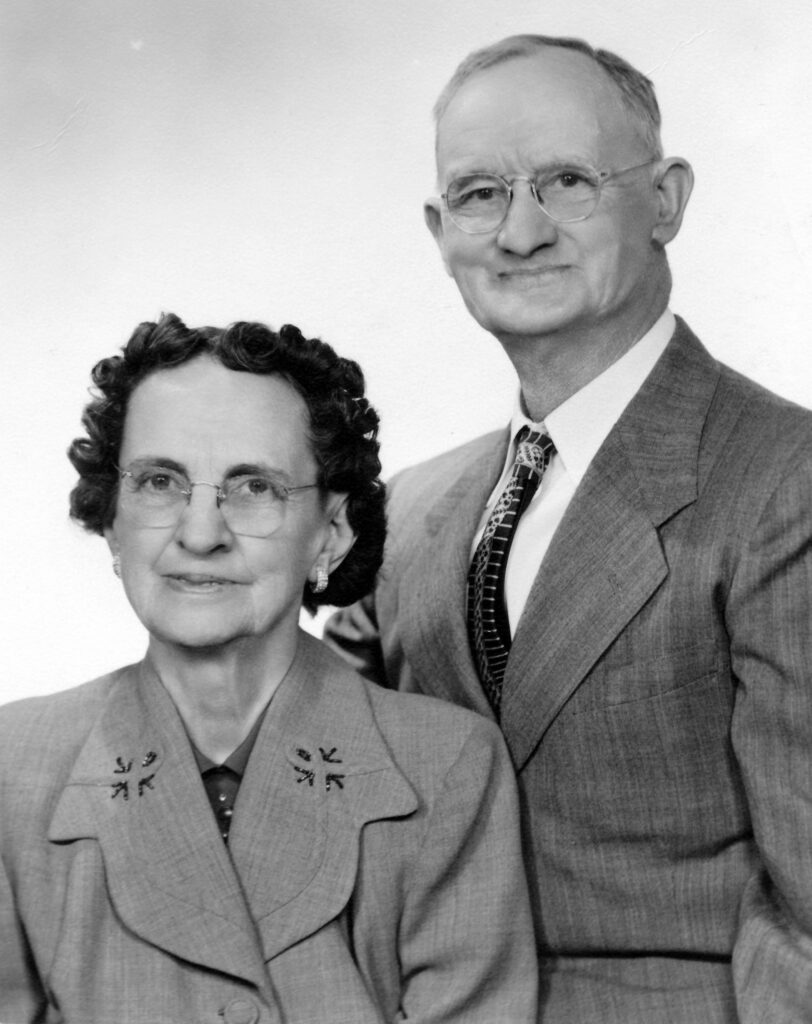
~John Hipe Hall and Effie Mae McIntire wedding day April 3, 1906~
~The Early Years in Kansas~ by Effie Mae McIntire Hall
Effie Mae McIntire was born on July 28, 1885, the eldest of five children born to Martin Luther and Sarah [Bridges] McIntire. Martin [born 5 February, 1850 in Keokuk County, Iowa] and Sarah [born 23 April, 1857 in Marion County, Iowa]were united in marriage in Marion County, Iowa on 12 December, 1882. Soon after their marriage, the young couple moved from Iowa and settled on a farm near the small community of Woodson in Rooks County, Kansas. Effie was born on that farm, and by 1895 the family was complete, with the arrival of Effie’s younger brothers and sisters, Avilon Perry [13 October, 1886–6 October, 1963], Nellie Grace [18 February, 1891–24 February, 1988], Oliver Simpson [18 December, 1893–24 December, 1943], and Eve Edna [born in Iowa — 4 November, 1895–17 September, 1896].
“One of my very first memories,” Effie wrote in her autobiography, “was going to town, or on errands with my father in our open, one-seat buggy, when I was about three years old. I must have been a very happy little girl dressed in a calico dress and broad-brimmed hat which I tied under my chin. One time, when we had driven seven miles to Alton, Kansas to do some trading, I spied some men unloading a dead calf, which they dragged from the wagon across the old board walk into the door of the meat shop. It was terrifying to me, and suddenly I screamed and raced up the street to our buggy. My embarrassed father ran after me to calm me down.”
As far as life on the Kansas frontier was concerned, Effie asserted that “the summers were hot, windy and dry with bitter cold winters. I recall in summer as I took water to the little chickens — running barefoot from one shade tree to another, stopping long enough to cool my feet, before I could go further. In winter, I remember mother hung quilts over the windows to keep out the cold wind, although we had a good frame house.”
“When I was five years old, my mother told me I would learn to read at school and I was very happy the day my father came home from town with my first school book, a Barnes First Reader. Books were not furnished by schools then. Soon a little girl wearing a big sunbonnet trudged alone through the tall prairie grass one and one-fourth miles to school. . . . At the end of the day I was eager to get home and tell my younger brothers and sisters about school. My teacher, Miss Man, was tall, red haired, and very nice to me. I remember very well that first day as I excitely turned through my first reader, telling my teacher what was in it. All through school I continued to like school and my teachers.”
“It was my duty of evenings to watch and care for my brother [Perry] and sister [Nellie] while my mother and father went out to the barn to milk. I remember especially the nights when the wind would howl mournfully across the prairie, around and through our house. Mother would always put the lighted lamp in a safe corner before going out, leaving me holding Nellie on my lap while we rocked in the old rocking chair. I was always glad when my parents returned to the house.”
Effie McIntire’s future husband, John Hipe Hall, was told many stories about Effie’s life in Kansas. Decades later Hipe offered the opinion that “Times were really rough out there. Many a year the only Christmas was a barrel of apples and nuts sent out from Iowa. . . . Everyone worked hard out in Kansas. Effie worked in the fields, as did her brother Perry. One time they were hoeing corn, Effie cut her foot with the hoe, put dirt in it to stop the bleeding, swore Perry to secrecy, and went on hoeing corn.” Following the drops of blood in the field, her father Martin found Effie. He “was horrified at what she had done; he exchanged the dirt for a wad of chewed tobacco. She survived.”
Hipe recalled that “Effie was creative, always wanted pretty things.” One time when her mother Sarah was preparing a meal for the workers threshing wheat, Effie took Bluing “and put tiny flowers on all the dishes.” Hipe added that Effie’s mom had to wash all the color off the dishes before they could be used.
“Another time [Effie] wanted a stylish dress to wear to school, so took her only dress (while her mother was away visiting), and took part of the fullness out of the skirt to make puff sleeves. When her mother came home, she saw Effie had the stripes going the wrong way on those ‘beautiful puffed sleeves’. She told Effie she would have to wear it, as there was nothing to make another dress.” Hipe noted that Effie was teased at school by the other students, “but she held her head high,” and always tried to be better than the other kids in academics. “She liked to study, loved music, as did all the McIntires in Kansas.” In fact, several of Effie’s relatives wrote songs and taught music “to supplement their meager farm income.” They formed the company M. L. McIntire and Sons and sold sheet music with such titles as My Childhood Home, Sweet Memories, and Love me Just the Same.
Martin Luther and Sarah McIntire had moved to the northern Kansas frontier, along with thousands of other families, drawn in part by the success of farmers in the region growing corn and newer varieties of wheat imported from Europe. In the late 1880s and the early 1890s, however, a combination of severe drought — John Hipe Hall stated Effie’s family was only able to raise three crops in ten years — and the National Depression of 1893 crushed the dreams of many of these immigrants, and around 1894 the McIntire family headed back to Iowa in a prairie schooner, seeking a better life.
Note on Sources — All of the quoted material by Effie McIntire Hall appears in “Autobiography: Effie Hall,” an undated, typed manuscript, prepared for a college class in the early 1950s at Mesa Junior College [now Colorado Mesa University] in Grand Junction, Colorado. I obtained a copy of Effie’s autobiography from my mother, Edna Hall Miller. The stories by John Hipe Hall appear in Wilna Treichler, It’s been a Honey,” self-published, 1983. Prior to her passing in 2008, Wilna graciously gave me written permission to utilize her material about Hipe.
Edited by John W. Miller
theoldprofessor7@gmail.com

~John Hipe Hall and Effie Mae McIntire~ Early Years in Iowa


John Hipe Hall was born in southern Marion County, Iowa on October 24, 1882. His parents, John and Mary (Long) Hall, owned a farm 1 ¾ miles east of the town of Attica. In the 1880s, Attica had about 1,100 residents and the surrounding area consisted of small farms and a few coal mining operations. Since John Hipe Hall’s father’s name was John, everyone referred to John Hipe Hall as “Hipe.” Hipe had ten brothers and sisters and three half-siblings from his father’s previous marriage to Marjorie Rogers.
Hipe’s grandparents, Martin and Susannah (Kee) Hall, had purchased 40 acres of timbered land east of Attica in 1851. By 1875 the Hall farm had grown to 80 acres, and by 1901 Hipe’s father John had increased the family’s holdings to 110 acres. Hipe was born in a log cabin that his grandfather Martin Hall had built in the 1850s. In the late nineteenth century, John Hall built a new log house and Hipe reflected decades later about growing up in this home: “I can remember well my mother sitting and knitting, laughing her soft laugh, and telling us children’s stories on a cold winter evening. My father would be sitting in a corner reading by coal oil lamp light.” Hipe recalled that he, his sister Ida, and his brother Mart would take turns washing and drying the dishes.
Hipe’s mother Mary used her Howe sewing machine to make all the clothing for the family, except for a few store-bought overalls for her husband and the older boys. “She made our underwear from outing flannel [a soft, warm cotton fabric], our shirts of cotton shirting, either plain blue or red and white striped. Mother knit our socks, mittens and gloves.”Hipe noted that everyone dressed warmly in the winter because the house was cold, heated only by a cook stove in the kitchen and a Round Oak heating stove in the living room. “Mart and I had to cut the wood and take turns starting the fires in the early morning. I can still hear dad calling out to me, ‘Hipe, it’s time to start the fire’ and I would reply, ‘It’s Mart’s turn.’”
Hardwood timber and coal were used to heat the family stoves. The Hall farm property contained two veins of coal – one was a shallow, surface vein and the other vein was deep. Hipe’s parents sold the deep coal vein and kept the shallow vein for their personal use. Carpets for the floors were made from old clothing scraps woven together by a neighbor. Oat straw was spread on the floor under the carpet to serve as padding. Oat straw was also used for mattresses. There was no heat in the bedrooms and on cold nights Hipe stayed close to the heating stove until his dad yelled “bedtime” and then Hipe would jump into his bed,still wearing plenty of clothes. On the coldest winter mornings, with low temperatures of -15 to -20, Hipe would awaken to find frost on the outside of the comforter.
When he was two years old, Hipe’s father gave him and his 11-year-old half-brother Will a “runt pig” on the condition that they would take care of the animal. The boys decided to make a food trough for the pig by hollowing out a log. Hipe’s dad had a rule against the children using his tools, but Hipe and Will decided to take a hatchet from the tool box to use on the log. “We took turns chopping. It was Will’s turn and I raked out chips just as Will chopped – getting the end of my middle finger on my left hand, cut it off.” Hipe yelled and his 13-year-old half-sister Viola came running and helped stop the bleeding. As Hipe remembered, “I can still see Will sitting in the little rope swing. Just heartbroken. He gave me his little wagon, his little shovel and his little drum with the real leather head, about everything he had.” Hipe said that throughout his life little kids always looked at his missing fingertip and that it helped him get acquainted with children.
Hipe attended school at the nearby Carlisle School until he was 12 years old. This one-room school, witha “pot belly” stove for heat, had one teacher who held sessions in the fall, winter, and spring. The winter session was the most popular, with up to 40 students enrolled.Hipe noted that “After our formal schooling came to an end, our father took over, teaching us the skills of farming, caring for livestock, rough carpentry, blacksmithing and mining.”
The girls in the Hall family kept busy with many chores. The laundry was done with a manual washing machine worked by a hand lever and a hand wringer. The boys were expected to help by occasionally “spelling” the girls with the washing. The girls on the Hall farm used a “sad iron” (from the Old English word for solid) to get the wrinkles out of clothing. The “sad irons” were made from cast iron and weighed around 7 pounds, with a metal or wood handle on the top. The irons were placed on top of the stove to heat, then used on the clothing until the irons lost their heat, then back on the stove top to be reheated. According to Hipe, “Those ol’ sad irons, boy, were they great to tuck into a cold, cold bed.”
The girls were also expected to help cook the daily meals for the family, as well as prepare food for crop-harvesting crews and for the many relatives and friends that came by the farm for either a meal or for the weekend. According to Hipe, “All meals were big meals as we worked hard.” Hipe’s favorite breakfast was a big platter of some kind of meat, along with eggs, some type of hot bread,and biscuits or mush, coated with sorghum molasses, honey, or jam.
Hipe learned from his father to be “a good shot” with the muzzle-loading rifle that Hipe’s grandfather Martin Hall had brought from Indiana to Iowa. Hipe and his brothers and sisters shot rabbits and squirrels for food and they butchered cows and hogs to provide fresh and dried beef, fresh and cured ham and sausage, and lard for cooking.
John and Mary planted an orchard on their farm and they always grew a large garden. Hipe recalled that “We had peaches, apples to dry for the winter, as well as corn and green beans. The green beans were dried over a string. For jams we gathered wild raspberries, gooseberries and plums.” Every fall, Hipe and his siblings gathered hazelnuts (also known as filberts), hickory nuts, and walnuts by the bushel for use during the winter.
As the Hall family grew larger, John and Mary hired local contractor Oliver McMillan to build a brand new, four-bedroom house, which was constructed for $1,500. The foundation for the new house came from limestone quarried at Walnut Creek, a few miles north of the farm. The log room from the old farmhouse became a stable for horses, and the kitchen from the old house was moved and became an outside summer kitchen. The new house had nine rooms, with three of the four bedrooms located on the second floor and “each equipped with a clothes closet.” The main floor included the kitchen, a large living room, and a parlor “for courting or company” that featured a store-bought rug and a small heating stove. A large heating stove was in the middle of the living room and a vent in the ceiling allowed some heat to go up to the second floor. The house used carbide gas for light, which Hipe noted was much better than the old coal oil lamps. Although equipped with some modern conveniences, there was still no indoor plumbing, so the family used an outhouse, which had a wood seat that Hipe remembered as being quite cold in winter.
As the new house was being built, Hipe and Mart were informed by their father they would need to wallpaper all the rooms in the new house. The boys received some advice from their mother about how to hang wallpaper, but Hipe lamented that neither he or Mart “knew how to put up wallpaper, but by the time we finished all those rooms, we knew how.”
Friends and family often paid a visit to the Hall farm for a night or for the weekend. “When company came, mother would tell us boys to go out and kill four or five chickens for supper.” At bedtime all the boys would find sleeping spots in the barn or in the summer kitchen. The girls would find space on the floor in the house. The grown-ups got the beds. “We always made room, had plenty to eat, and had lots of fun calling each other names and kidding around.”
A regular visitor to the Hall home when Hipe was young was an elderly neighbor, Tommy Locke, who “used to come over to argue scripture with dad. They would get to going and Tommy would stay for supper, then afterwards they ‘go at it again.’ It sure upset us kids. Those two sure knew their scripture.”
Hipe and his family attended church services both in Attica and at a chapel a few miles north of the Hall farm on land owned by Thompson Bridges, the grandfather of Hipe’s future wife, Effie McIntire. Families came to the Bridges chapel from the surrounding area once a month for services. “Church lasted until 2PM and did those walnut benches ever get hard. Some of those itinerant preachers really got going,” Hipe recalled. “Then there was the singin’ without musical instruments and some of those ol’ souls couldn’t carry a tune in a bucket, but they sang from the bottom of their hearts. Then came lunch and the long trip back home by team and wagon. Three or four miles was a ‘long way.’”
Telephone service came to the Hall farm around 1895. Neighbors worked together to set oak poles in the ground and they purchased wire and insulators from the telephone company. “In times of sickness or when one needed an errand run, the telephone was wonderful.” One time when a neighbor’s barn caught on fire, everyone was alerted by phone and ran to help put out the fire.
As a teenager, Hipe enjoyed gathering with other kids in the neighborhood for taffy pulls and Sunday evening church activities in Attica. Hipe’s father would not permit card playing in the house, so Hipe and his brothers would sneak off to the hayloft in the barn to play Euchre and other card games. During the winter, playing checkers was a popular pastime on the Hall farm. Hipe, Mart, and their dad played almost every night. Later in life, Hipe always enjoyed playing checkers with his grandchildren. Baseball games were held every Saturday during the warmer months. Hipe played third base for the Attica Stars and they played games against other nearby communities, with the host town providing a lunch. Hipe noted that in the 1890’s only the catcher and the first baseman wore baseball mitts.
When Hipe was 18 years old, his younger brother Ora Dick Hall passed away at age nine from typhoid fever. Ora Dick was buried in a white casket that was purchased for $25. The funeral was held at the Hall farmhouse and then the casket was placed on the back of a wagon and taken to the Carlyle Cemetery, where Ora Dick was buried next to his grandparents, Martin and Susannah Hall.
The goal of many young men at that time was to own their own horse-drawn buggy. A neighbor had a nice buggy available for sale for $65, but Hipe did not have that much money, so the neighbor said Hipe could take the buggy and make payments over the next few months. Hipe’s father was not pleased that Hipe had accepted the buggy before it was paid for, but John then told Hipe he could “fatten up” some of the young pigs to pay for the buggy. Hipe loved to drive the buggy at a fast speed, with his favorite “high-stepping” reddish-brown bay horses. He delighted in racing against other buggy drivers, and Hipe claimed he won most of those buggy races.
When he was 21 years old, Hipe hired out to work for neighbor Fred Bellamy. Bellamy provided room and board for Hipe and his horse and Bellamy paid Hipe $25 a month, which was considered a very good wage at that time. As far as working conditions were concerned, Hipe explained “I always tried to be a good hand. We worked in the fields ten hours, then after supper I did chores, milking cows and feeding hogs.”
Effie Mae McIntire
Just north of the John and Mary Hall property was a 40-acre farm owned after 1895 by Martin Luther and Sarah (Bridges) McIntire. Martin and Sarah were married in Iowa in 1882 and three years later they moved to Rooks County, Kansas. Martin and Sarah were the parents of five children: Effie, Perry, Nellie, Oliver, and Edna Eva (who died at the age of 10 months).
Effie, who was born on July 28, 1885, recalled her early life on the Kansas frontier–“the summers were hot, windy and dry, with bitter cold winters. In winter, I remember mother hung quilts over the windows to keep out the cold wind.”
Since Effie was the oldest child, she had to watch her younger brother Perry and younger sister Nellie each evening when her parents went to the barn to milk the cows. “I remember especially the nights when the wind would howl mournfully across the prairie, around and through our house,” Effie recalled. “Mother would always put the lighted lamp in a safe corner before going out, leaving me holding Nellie on my lap while we rocked in the old rocking chair. I was always glad when my parents returned to the house.”
After a decade of living on the plains of northern Kansas, Martin McIntire decided it was time to return to Iowa: “After ten years of pioneering, experiencing droughts, hot winds and grasshopper plagues, I moved my family [back] to Iowa in a prairie schooner in 1895, where we bought a farm and resided until 1907.” Martin and Sarah McIntire had moved to the Kansas frontier, along with thousands of other families, drawn in part by the success of farmers in the region growing corn and newer varieties of winter wheat imported from Europe. In the late 1880s and early 1890s, however, a combination of severe drought and the national Depression of 1893 crushed the dreams of many of these farmers and the McIntire family traveled back to Iowa seeking a better life. When Martin and Sarah McIntire and their children returned to Iowa, Sarah’s parents, Thompson and Mary (Anderson) Bridges, helped the McIntire family obtain a 40-acre farm located just north of the John Hall farm. The Hall and McIntire children got together for social activities and to help their parents with farm work. An example of the latter occurred each fall when the two families worked together to harvest the sorghum crop. The Hall and McIntire families worked from 7AM to 8PM at the local sorghum mill to process the sorghum into a sweet “molasses” product by extracting the juice from the crushed stalks of the sorghum plant. The juice was then heated to steam off excess water, leaving the syrup behind. It was during these social and work activities that Hipe Hall enjoyed keeping company with Effie McIntire.
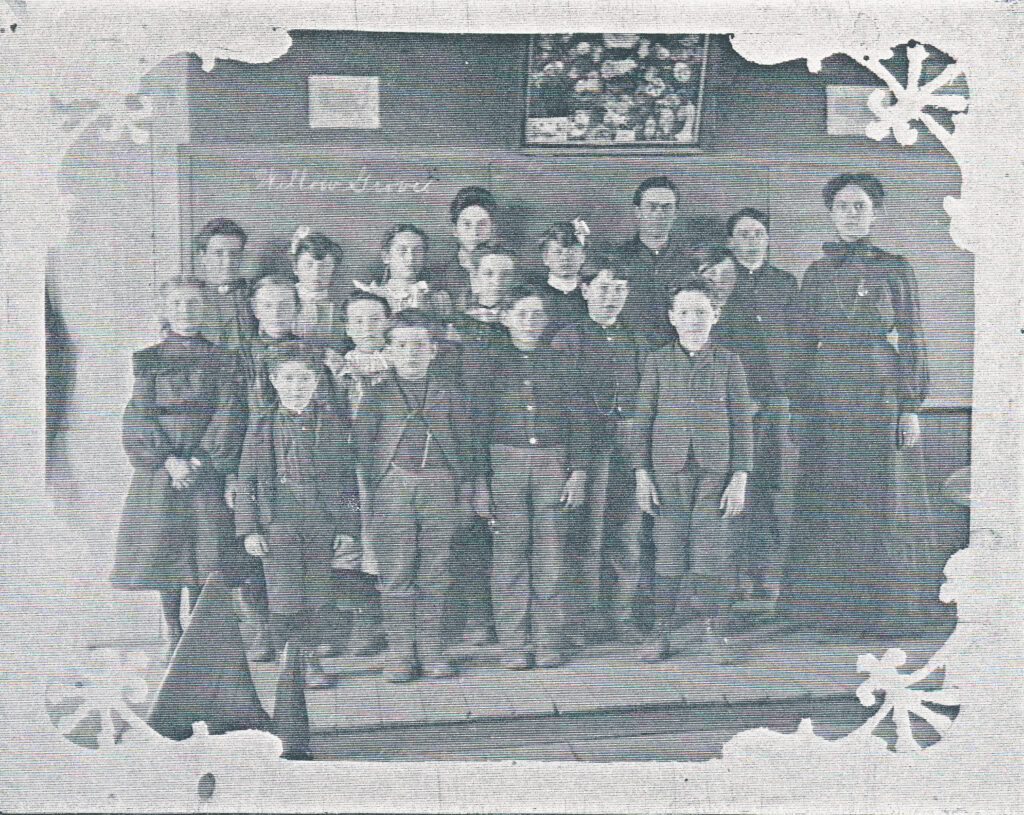
In 1901, although only 16-years-old, Effie McIntire secured a teaching job at the Willow Grove school, located in a rural coal mining area several miles south of Attica. As Hipe explained, “In those days, if you finished the eighth grade, you could pass a test for a teaching certificate and teach school.” Young, single school teachers like Effie often obtained room and board during the week at the home of one of the families who lived near the school and then returned to their own home on weekends. One very windy day at the Willow Grove school a little girl named Mary left the classroom and did not return. Effie sent another girl out to investigate. That girl hurried back to the classroom and exclaimed “Oh teacher, Mary’s crying, the outhouse has blown over, the door is shut fast, and Mary can’t get out.” Effie quickly sent the older boys to rescue Mary.In the fall of 1903, Effie McIntire enrolled for a year of teacher preparation courses at Iowa Central College in the nearby town of Pella. Hipe’s older sister Ida was also enrolled at Central and Hipe occasionally drove his sister to Pella in his buggy. Hipe enjoyed being around the young women at the college – “it was natural to cast my eyes around to see who was watching me and which one’s I’d like to court.”But Effie soon won Hipe’s heart and Hipe believed that his close friendship with Effie’s brother Perry may have helped with his courtship of Effie. Hipe recalled that he “had it bad” for Effie and he hoped she cared for him as well. Hipe decided to propose marriage to Effie and she accepted.
John Hipe Hall and Effie Mae McIntire were married on April 3, 1906 at the Missionary Baptist Church in Knoxville, Iowa. Hipe was 23 and Effie was 20. Effie’s mother made the wedding dress — “a belted creamy white swazette, high neck, long sleeves, lots of tucks and lace. The long skirt had a wide flounce at the bottom.” Hipe wore a worsted wool suit. After the wedding ceremony, the newlyweds went to the McIntire home for an oyster stew supper and spent the night at the farm. The next day Hipe and Effie drove to the Hall farm, where John and Mary gave the newlyweds a reception. Effie wore a long black silk dress at the event. Hipe and Effie then took up housekeeping at a nearby rented farmhouse.
In 1906, Effie’s father Martin Luther McIntire and her brother Perry took a trip by train to western Colorado. Martin wrote that he was quite impressed by what he saw on the trip – “the fruit orchards, wonderful fields of wheat, oats, barley, alfalfa and what wonderful cattle, sheep and horse country it was.” Martin was convinced his health would be better in the drier climate, so he made plans to move his family to Olathe, Colorado. The primary difficulty with farming in western Colorado at that time was the lack of water. Crops in the Olathe area had to be irrigated and the water sources were not reliable. But Martin was encouraged by a major irrigation project that was underway to divert water from the Gunnison River to the Olathe area via a system of tunnels and canals.When Martin returned to Iowa after the Colorado trip, he and Sarah sold their farm and prepared to move west.
Hipe and Effie Hall decided to join Effie’s parents in the move west to Olathe. As Hipe explained, “Effie and I had been married for almost a year, we had $400 and some livestock, and we thought it would be fun to go along.” In January 1907, Hipe and Effie traveled from Iowa to Olathe on an “immigrant train” that transported people, household furniture, farm equipment, and livestock. Hipe described the possessions that he and Effie took with them – “household furniture, barrels of dishes, boxes of bedding, canned fruit, five or six dozen chickens in crates, two milk cows, a team of mules, a driving mare, plus feed for the animals, a harness, a top buggy, a carriage and a wagon.” The trip from Iowa to Olathe took several days, since the emigrant train occasionally had to wait on a side track while other trains passed and because federal law required livestock be taken off the train every 24 hours to rest and move about. Hipe and Effie were joined on the train by Hipe’s brother Mart; Martin Luther and Sarah McIntire and their children, Perry, Oliver, and Nellie; Effie’s aunt and uncle Jim and Mary Bridges and their young children Florence and Eleanor; and Alex Greeson, one of Effie’s cousins. When they arrived in Olathe, Hipe, Effie, and the rest of the travelers were met by friends from Iowa who had previously relocated to Colorado.
Decades later, Hipe reflected on the decision to move west: “I’d left green lush cropland that didn’t have to be irrigated for this, and I would fight high freight rates, carry an irrigation shovel over my shoulder all my years on the farm, and although I cussed and swore about it, I never thought about going back. To go back would have meant I’d failed. Life out here was to be hard, but now looking back, it’s been a good life, such good people, such wonderful friends, and we were all in it together, all trying to make a living.”
Notes
This story is continued in: “Living in Olathe, 1907-1944: John Hipe Hall and Effie (McIntire) Hall” and “John Hipe Hall and Effie (McIntire) Hall: The Retirement Years,” available on Ancestry.com or from the author at theoldprofessor7@gmail.com
~John Hipe Hall and Effie Mae McIntire Hall~ The Olathe Years 1907-1944
This story is a continuation of “John Hipe Hall and Effie Mae McIntire: Early Years in Iowa.”
John Hipe Hall and Effie Mae McIntire were married on April 3, 1906 in Knoxville, Iowa and moved from Iowa to Olathe, Colorado in January 1907. Effie and Hipe traveled to Colorado on an “immigrant train” filled with people, household furniture, farm equipment, and livestock. Hipe and Effie were joined on the train by Hipe’s brother Martin “Mart” Hall; Martin Luther and Sarah McIntire and their children, Perry, Oliver, and Nellie; Effie’s aunt and uncle, Jim and Mary Bridges and their young children, Florence and Ruth; and Alex Greeson, one of Effie’s cousins. When they arrived in Olathe on January 23, 1907, Effie, Hipe, and the rest of the travelers were met by friends from Iowa who had previously relocated to Colorado.
In the spring of 1908, Hipe and Effie filed for 80 acres of government homestead “adobe soil” land located three miles northeast of Olathe. The soil was suitable for growing crops if adequate water could be applied, but in 1908 there was no irrigation water available. The Gunnison River diversion project was underway to provide irrigation water to the Olathe area, but canals had to be constructed to deliver the water. Effie and Hipe worked on nearby farms until the irrigation water was available at their homestead. Hipe also did carpentry work for a neighbor and Hipe helped build the wooden structures for diverting water from the irrigation canals. Hipe also worked on the digging of the Ironstone canal west of Olathe and he was paid $4.80 per day “for a man and his wagon and a team of horses.” Hipe considered his pay to be “excellent wages at that time.”
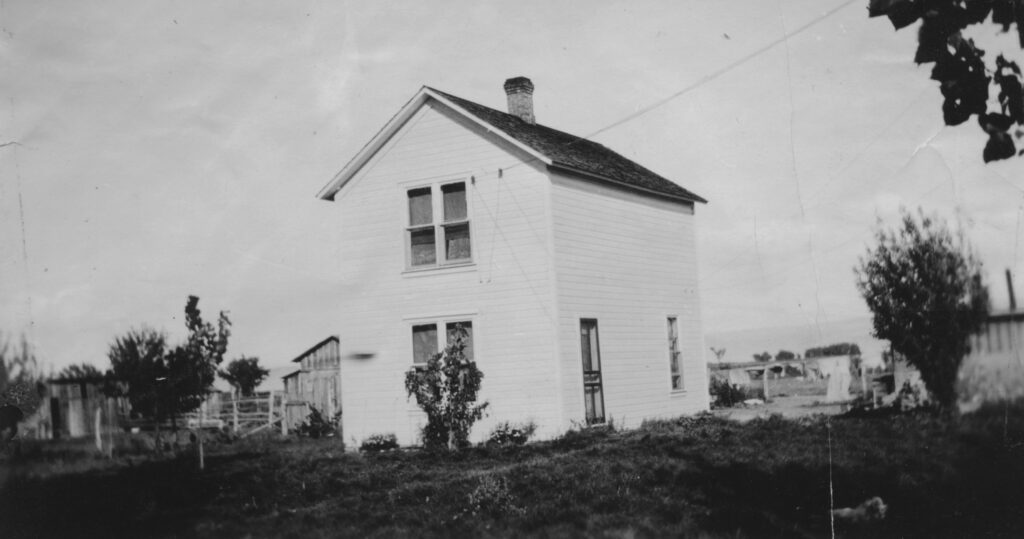
In the fall of 1908, Hipe and his brother Mart built a 3 room, 2 porch house on the 80-acre homestead. The home was built with pine lumber and the floors were laid with wide spruce boards. Effie and Hipe moved into the house the following year and Mart decided to return to Iowa. The house lacked modern conveniences; there was no electricity and drinking water had to be trucked in and stored in a cistern. The furnishings included a few items Effie and Hipe brought from Iowa, including a cook stove, a foot-pedal organ, a bedroom dresser, and a double bed. After arriving in Olathe, Hipe and Effie purchased a table and 6 chairs, a kitchen cabinet, and a guest bed. Clothing was hung on nails driven into a board on a wall.
Hipe dug an outside cellar for fruits and vegetables and he began fencing in the 80 acres. For the fence, Hipe and a neighbor gathered cedar wood from the Black Canyon area east of Olathe. Hipe then made fence posts from the cedar wood, set the posts in the ground, and strung barbed wire between the posts. Hipe built a corral for their 5 horses and constructed an enclosure to house several dozen chickens and a few turkeys.
For their household cooking, Effie and Hipe used both “pinon pine” wood and coal. Pinon pine was available for cutting in the wooded areas east of Olathe and Hipe would occasionally take a horse-drawn wagon 30 miles north to the coal mines near Cedaredge, where he would purchase coal for $1.25 a ton, then camp overnight and return home the next day.
After the irrigation canals were completed and the Hall homestead had a steady supply of irrigation water, Hipe planted 40 acres on the farm in hay, potatoes, and sugar beets, while keeping the other 40 acres in pasture for the livestock. Near the house, Effie and Hipe planted shade trees, roses, and a lawn. At that time, Hipe expressed the opinion that “we were beginning to see progress.”
One year, Hipe took a wagon load of apples, onions, and potatoes to sell in the mining town of Silverton, 70 miles south of Olathe. Twenty-three miles of that distance involved negotiating narrow, steep roads, including over Red Mountain pass, at an elevation of 11,075 feet. In Silverton, Hipe discovered that the miners had very little money, “so I wound up making fifty cents and gave the rest of my load away.”
Effie took butter and eggs from the farm to sell in Olathe, and she secured a teaching position at the Frost School, located six miles south of their home. Effie taught all eight grades at the school. During good weather, Effie went back and forth to the school in a buggy pulled by their farm horse “Old Bill.” During the winter months, Effie boarded during the week with families near the school and drove the buggy home on weekends.
During the summer of 1910, both Effie and Hipe caught typhoid fever and nearly died. Hipe wrote that “Effie went to bed one day; I went the next.” They were treated by Dr. C. E. Lockwood of Olathe, assisted by a nurse who stayed with the couple. Effie’s mother, Sarah (Bridges) McIntire, helped with their care and Jim and Tom Bridges tended to the livestock. Hipe recalled that “Getting over typhoid was really something. We were both so thin we carried a pillow to land on.” After a pipeline was built to carry water from a mountain spring to Olathe, good drinking water became available and Hipe and Effie used the cistern on their farm to store the clean water.
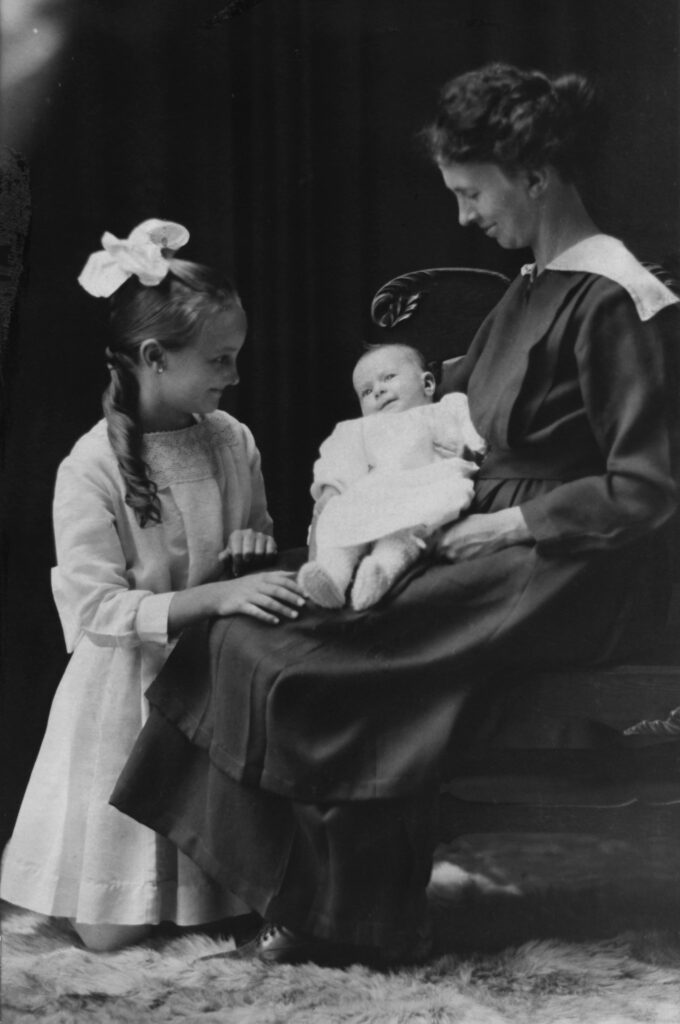
After the couple recovered from typhoid fever, they decided to start a family. On November 25th, 1911 Effie and Hipe’s first child, Wilna Ethyl Hall, was born. As a child, Wilna enjoyed exploring with her little black dog, riding horses around the farm, and trying to milk cows.
While they were living on their homestead northeast of Olathe, Hipe and Effie made the acquaintance of George W. Howard, who had served as a scout for Buffalo Bill, fought in the Civil War as a member of the First Colorado Cavalry, and was one of the early gold and silver prospectors in southwest Colorado. In 1873 Mr. Howard built the first cabin in Howardsville, four miles northeast of Silverton, and he developed several mining claims in that area. In the 1880’s Howardsville was a thriving settlement, with a population of 150, several businesses, and the first post office located in southwestern Colorado.
Mr. Howard mentioned to Effie and Hipe that he was looking for a place near Olathe to spend the winter months each year and they told Howard that he was welcome to build a cabin at the north end of their 80 acres. Shortly thereafter, Howard constructed a 20-foot by 14-foot wood cabin. Wilna enjoyed listening to Mr. Howard’s stories about his scouting adventures with Buffalo Bill and Howard’s military service during the Civil War. Mr. Howard was glad to share his stories, but only after Wilna had helped Effie wash the dinner dishes.
Hipe and Effie had made a success out of their 80-acre homestead, but the couple decided they would prefer to live west of Olathe, closer to the farm of Effie’s parents, Martin and Sarah McIntire. In 1917 they purchased 40 acres of irrigated farm land and a 2-bedroom house on Ash Mesa from Fernando “Pete” and Lucinda Shields for $4,000. The location of this farm was two miles west and one mile north of downtown Olathe. Hipe recalled that the prices farmers received for their crops between 1915 and 1919 were good and he and Effie were able to pay off their mortgage on the new farm in just 4 years. Effie and Hipe added 20 more acres to the farm in 1921 and an additional 20 acres in 1929. George Howard’s cabin was moved from the old homestead to the new Hall farm and Effie and Hipe rented out their former homestead land.
The house on their new Ash Mesa farm already had electricity, so Hipe and Effie were able to use electric lights, an electric clothes washer, and an electric iron. Hipe installed an electric pump in the kitchen to bring water into the house from the outside cistern. After settling into their new place, Effie secured a teaching position at the nearby Highland school and Wilna started school at Olathe Elementary during the 1916-1917 school year. Wilna rode to her school in a covered wagon pulled by two horses and driven by Mr. Perry. In April 1917, America entered World War I and Hipe received a deferment from the military draft, since farmers were needed to raise food for the war effort.
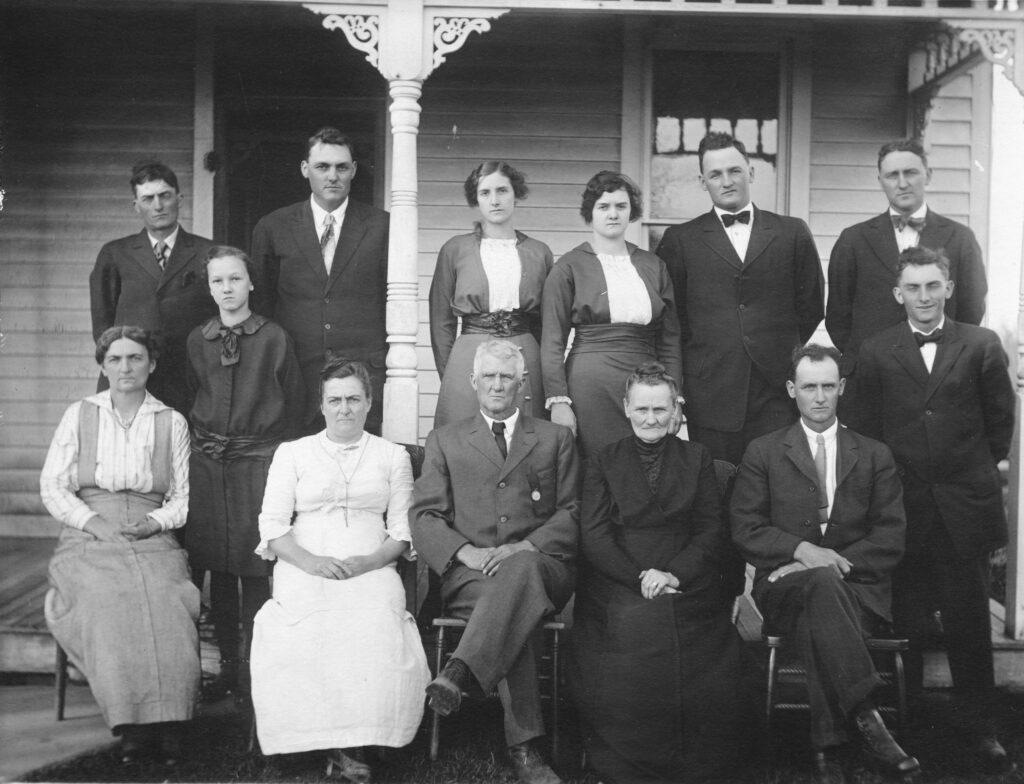
Hipe observed that, “It was lonesome living in Colorado away from my family, however I did try to get home each year or two.” In November 1917, Hipe joined his ten living siblings for a family reunion in Attica, Iowa. Two years later, Effie and Hipe made a six-week visit to Iowa, along with their seven-year-old daughter Wilna, who charmed the Iowa relatives. The relatives in Iowa also made trips to Colorado to visit Hipe, Effie, and the McIntire families. When they came to Colorado for a visit, the Iowa relatives loved to go fishing and to take scenic drives into the nearby mountains.
In 1918, Effie and Hipe purchased their first automobile, a brand-new, 4-door Chevrolet “Four Ninety” model. The couple paid the Chevrolet dealer in Montrose $750 for the car, with $400 as a down payment and the remainder to be paid in the fall after the crops were harvested. Neither Hipe nor Effie knew how to drive an automobile, so Hipe took a ride in neighbor George Broughton’s car for a while, then Hipe got in the driver’s seat of George’s car and drove around on Olathe’s dirt roads until he felt confident enough to pick up his new Chevrolet in Montrose.
Also in 1918, the “Spanish flu” epidemic arrived in Olathe. Hipe was the first to fall ill with the flu and Dr. Lockwood prepared liquid medicine for Hipe, Effie, and Wilna and told them that Effie and Wilna would soon also get the flu and for the three of them to take the medicine and rest in bed. As Hipe explained, “Man, were we sick. I was so weak I could hardly take care of the livestock. Boy, did I ever appreciate that electric pump for the stock water well. Those ol’ cows would have choked [died] without the electric pump.”
On August 10, 1920, Effie and Hipe’s second daughter was born — Edna Luree Hall. In December of that year, eight-year-old Wilna composed a handwritten note to Santa Claus:
I want you to bring some nice things to our house, for we have a baby girl. You have not seen her for she came this year. I will hang up her stocking to hold what you bring. I want you to bring her a rubber doll so she won’t have to eat her fist. And lots of nice things. I wish you would not bring so much to me, but bring some to the poor. We have a nice Christmas; the tree is nice.
Your little friend, Wilna Hall
The Hall family became members of the Olathe First Baptist Church. Effie had been baptized in Iowa in 1904; Hipe was baptized in Olathe in 1916; Wilna in 1921; and Edna in the early 1930’s. At First Baptist, Effie taught Sunday school, sang in the church choir, and served as the Sunday school superintendent for five years. Hipe admitted that “Harry Roadcap and I had many a nap in that old church. Pastor said he didn’t mind we went to sleep; he knew we had perfect confidence in what he was going to say.”
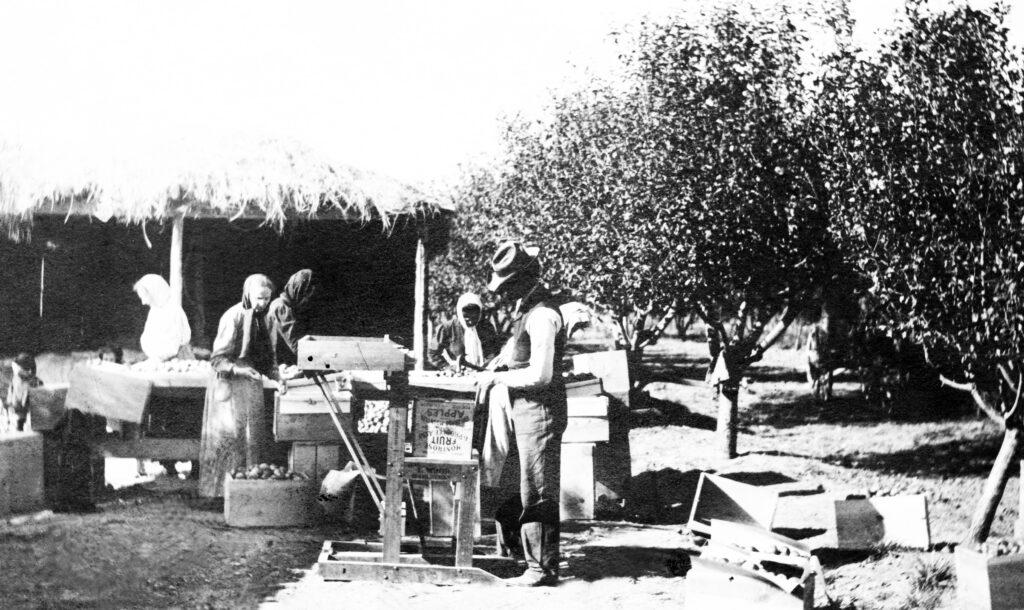
In the 1920’s, the Hall farm grew potatoes, onions, alfalfa, sugar beets, and corn. Effie and Hipe always had at least 100 fluffy, golden Orphington chickens, which were excellent egg producers. There were also cows, pigs, and sheep, along with 40 to 50 turkeys to sell at Thanksgiving and Christmas. The fruit trees were producing apples, apricots, cherries, peaches and plums, along with grape vines and blackberry and gooseberry bushes.
Unfortunately, just as the Hall farm began to produce abundant crops, the prices farmers received during the 1920’s fell dramatically. Apples that had sold for over two dollars a bushel between 1915 and 1919 were worth only 35 cents to 75 cents per bushel in the early 1920’s. Effie and Hipe’s daughter Edna recalled that the Ash Mesa farm had a big outdoor cellar where her parents would store apples, potatoes, onions, and other crops through the winter, hoping for higher prices in the spring. Some years that strategy paid off, but on a couple of occasions the spring prices for the crops were lower.
To help compensate for the low farm prices, Hipe and Effie tried every way they could think of to save money. Effie canned meat and vegetables and the family members all helped with drying apples and other fruit. Effie was adept at sewing clothes for the entire family. As Edna explained, Effie would take Wilna’s old clothing and remodel them or put two articles of clothing together to make one “new” one for Edna. Effie also earned money by serving on the local election board, substituting at area schools, and reporting on Olathe news for three newspapers: the Delta Tribune, the Montrose Daily Press, and the Grand Junction Daily Sentinel.
Effie had several hobbies, including crocheting, lacemaking, oil painting, and giving readings for church programs and at community events. Effie became very active in the Olathe Women’s Club, the 4-H Club, and the Colorado State University County Extension Club, where she enjoyed meeting individuals who came to Montrose County from the CSU campus in Fort Collins to share new ideas on cooking, canning, making candy, and other activities.
Hipe and Effie liked to fish, either along the Gunnison and Cimmaron rivers or at one of the many lakes in the nearby Grand Mesa National Forest. They enjoyed renting cabins on Grand Mesa and spending a few summer days at the higher elevation, where temperatures were significantly cooler than in Olathe. Years later, Hipe reflected “I’ll never forget those beautiful mountain flowers, Indian Paint Brush, wild roses, a wild cousin of every domestic flower we had at home.”
In the 1920’s, Effie and Hipe added on to their Ash Mesa home to create a larger living room with hardwood floors, a combination kitchen/dining room, and a new porch. Hipe did much of the work, assisted by a local carpenter.
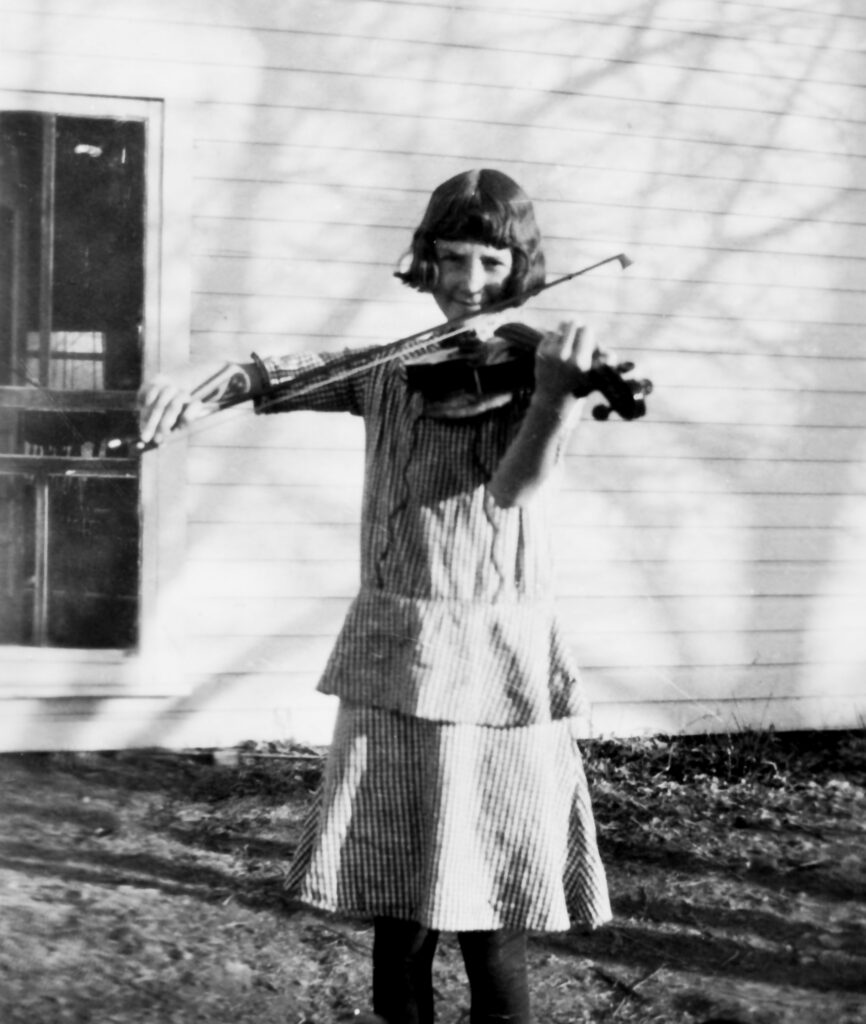
Both Wilna and Edna developed an interest in music at an early age. As a result, Effie and Hipe bought a used piano and then a Montgomery Ward mail-order violin for the girls and Effie taught them to play. Wilna did not care much for the violin, but she became a talented pianist and played for the Olathe Orchestra and the First Baptist Church and she gave private lessons to many in the Olathe area. Edna took to both the piano and the violin. During their high school years, both Wilna and Edna received recognition for their musical abilities and their many extracurricular activities, including awards at the Colorado State Fair.
Effie and Hipe were determined to provide their two daughters with a college education. After Wilna graduated from Olathe High School in 1929, she enrolled at Colorado State College of Agriculture and Mechanical Arts (now Colorado State University) in Fort Collins. In 1935, Hipe, Effie, and Edna drove to Fort Collins to watch Wilna graduate with a B.A. degree in Home Economics. That fall, Wilna took a job in Grand Junction, Colorado as the Mesa County home demonstration agent. In this capacity, Wilna was a local representative of the United States Department of Agriculture and the Colorado State University extension office. In April 1938 Wilna married Cyril Eugene “Gene” Treichler and the newlyweds often drove from Grand Junction to visit with Effie and Hipe in Olathe.
Edna graduated from Olathe High School in 1938 and enrolled at Western State College (now Western State Colorado University) in Gunnison. After her Junior year at Western State, Edna obtained a 3-year teaching certificate and secured a teaching position at the Fairview school, just 2 miles west of Effie and Hipe’s farm. Edna met Glen T. Miller at a Baptist youth activity in 1941 and they were married in June 1943. After Glen left for Europe during World War II, Edna returned to Western State and completed her requirements for a B.A. degree in Primary Education and Music. Edna then accepted an offer to teach a first-grade class for the 1944-45 school year at the Riverside Elementary school in Grand Junction.
At the end of the 1920’s, the nation settled into a decade of hard times known as the Great Depression. Hipe recalled that in 1931 both the local and the national economic conditions were “just terrible.” That year he sold two large pigs for less than $5.00 each and he sold potatoes for 40 cents per hundred pounds. Hipe fed some of his potato crop to the cows and he also mixed barley and potatoes to feed to the pigs. Effie and Hipe got so little for their apples that they bartered or gave away most of the crop. Hipe and Effie had trouble paying all their bills, but the utility company and most merchants were willing to accept partial payments, with the promise of continued payments until fully paid. Hipe did handyman work for the water association to help pay the irrigation water bill. Hipe commented that “We were never sued for a bill, but it took some doing.”
During the Great Depression, numerous farms in the Olathe area were foreclosed by the banks that held the mortgages. The local banker who held the mortgage on the Hall farm encouraged Effie and Hipe to keep the payments up to date for the property taxes and the irrigation water and “let the interest on the mortgage go” until they could find the money to pay. Despite the economic problems of the 1930’s, Edna recalled that as a child growing up during those years, she felt “very happy and secure” on the farm. “I do not remember the ‘Great Depression’ as such, but remember there was always plenty to eat, but hardly any money.” The Great Depression eased its grip on the US by 1940, with increased demand for farm crops and industrial goods as World War II raged in Europe.
After America entered World War II in December, 1941, there was a shortage of teachers in western Colorado. Effie decided to accept a teaching position for the 1942-43 school year at the West Redlands school, located several miles northeast of their Olathe farm. During the week, Effie lived in a one-room shack on the property of a school board member. Effie walked over half a mile each way to her school, where she was both teacher and janitor. During her second year of teaching at West Redlands, Effie became ill and ended up in the Montrose hospital. She was suffering from exhaustion and Effie reluctantly decided to end her teaching career.
As Hipe explained, “Mama had what her doctor said was a ‘nervous heart.’ I don’t know, she always worked so hard, always had two jobs waiting to be done. I think the poor old dear just wore herself out and got sick to give her body a chance to rest. This same thing happened several times in her life. She was always going to do something ‘if it kills me.’ A few times I really thought it would.”
Effie’s episodes of physical exhaustion continued and her doctor thought a lower altitude might be beneficial, so in February 1944 Effie and Hipe sold their farm and moved 50 miles north to Grand Junction, which was a little lower in elevation. Their decision to move from Olathe, which had been their home for 37 years, was made easier by the fact that both Wilna and Edna were living in Grand Junction while their husbands were serving in the military during World War II.
NOTES
Hipe and Effie’s retirement years in Grand Junction, Colorado will be covered in a future story.
The most useful source of information on John Hipe Hall and Effie McIntire is “It’s Been a Honey; ‘Old Dad’ Reminisces,” a typed collection of stories that was compiled in 1983 by Hipe and Effie’s daughter Wilna (Hall) Treichler. Additional material is found in: “Hall Family Genealogies” by Effie and Hipe’s daughter Edna (Hall) Miller, assisted by John W. Miller, 1983; “Early Years in Kansas” by Effie (McIntire) Hall, 1950, edited by John W. Miller; Letter to the Editor of the Olathe Express by Martin Luther McIntire, @1927; History of Marion County, Iowa, 1881 and 1975; Marion County Iowa 1875; Atlas of Marion County, Iowa, 1901; Martin and Susannah (Kee) Hall, story by John W. Miller available on Ancestry.com.
George W. Howard was born in 1842 and passed away in his apartment at the Sears Hotel in Denver in 1919. Before he died, Mr. Howard told Hipe and Effie they could have his cabin and the personal possessions inside the cabin. Several of the personal possessions, including Mr. Howard’s rifle, buckskin clothing, and bullet molds, have been loaned by the descendants of Hipe and Effie Hall for display at the San Juan County Historical Museum in Silverton. Mr. Howard’s rifle was a 16-pound Sharps 45-70 model with an octagonal barrel that was used to hunt buffalo and other large game.
Prepared by John W. Miller in 2022
Comments welcome at: theoldprofessor7@gmail.com
~John Hipe Hall and Effie Mae McIntire Hall~ The Retirement Years
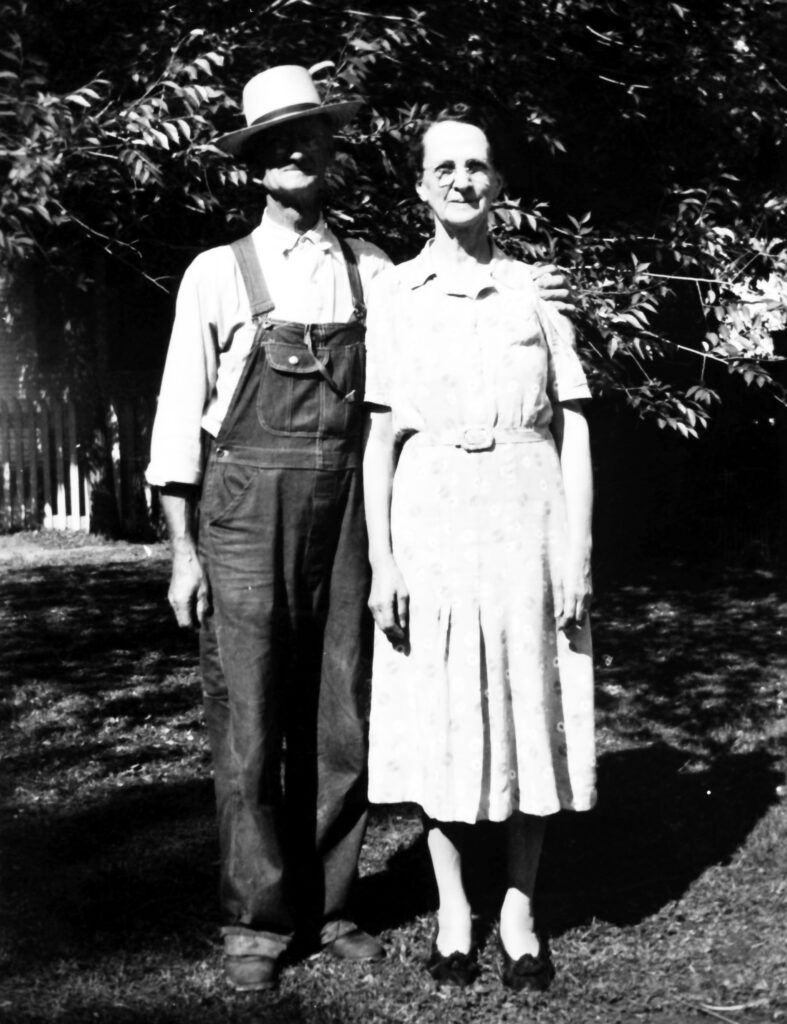
This story follows “John Hipe Hall and Effie McIntire: Early Years in Iowa” and “John Hipe Hall and Effie Mae (McIntire) Hall: The Olathe Years 1907-1944”
In the spring of 1944, Hipe and Effie Hall were enjoying life on their farm west of Olathe, Colorado. They had numerous friends and relatives in the area, but Hipe, now 61 years old, recognized that farm work was challenging and he was not getting any younger. Hipe was also concerned with Effie’s well-being. Effie’s doctor suggested that living at a lower altitude might improve her general health and alleviate her bouts with exhaustion. So, Hipe and Effie made the decision to move 50 miles north to Grand Junction, Colorado. Their choice to move from Olathe, which had been their home for 37 years, was made easier by the fact that the couple’s two children, Wilna Treichler and Edna Miller, were both living in Grand Junction while their husbands served in the military during World War II.
In March 1944, Effie and Hipe sold their Olathe farm, along with the livestock and equipment and some of their household belongings. They moved to Grand Junction and rented an apartment on Rood Avenue, just west of 11th Street. They soon became good friends with next-door neighbors Horace and Irene Wubben. Horace was the president of Mesa Jr. College [now Colorado Mesa University] and Irene was a librarian at the Mesa County Library. Effie and Irene enjoyed each other’s company in part because they were both former school teachers.
Hipe decided that he would look for a part- or full-time job in Grand Junction. Hipe spoke with Ralph Stocker, an old friend who had once lived near Effie and Hipe’s Olathe farm. In 1944 Ralph Stocker was the director of the Grand Junction Parks Department and Stocker offered Hipe a full-time position with the Parks Department. Hipe’s duties included watering and mowing at the Lincoln Park Golf Course and caring for the rose gardens at the city parks and the city hall. When it was too cold to work outside, Hipe did indoor projects, such as painting city offices and park buildings.
Hipe noted that the primary difference between having a farm and working for the Grand Junction Parks Department was that with the Parks Department he would put in his hours and go home. After work, “I could stand around and visit with my neighbors.” Hipe enjoyed the work so much that he kept the Parks job until he was 72 years old.
The apartment on Rood Avenue was adequate for Effie and Hipe’s initial residence in Grand Junction, but Hipe really wanted to purchase a home where he “could have a nice yard, flowers, and a garden.” So, in December 1944 the couple purchased a duplex at the corner of Belford Avenue and 6th Street. Two years later, in October 1946, Effie and Hipe sold the duplex and purchased a home at 1157 Ouray Avenue. This attractive, single-story bungalow with white wood siding featured 2 bedrooms, 1 ½ baths, a kitchen, a comfortable living room, plus a large unfinished room in the basement. The front yard had a nice lawn and two locust trees. On the east side of the home, a gravel driveway led to a detached single-car garage. The backyard had a Russian olive tree that the grandkids loved to climb, a small lawn, and a large garden area where Hipe planted roses, peonies, tulips, iris, and other flowers, plus a vegetable garden.
The home on Ouray Avenue was in a friendly neighborhood, with several older couples, widows, and widowers. The location was convenient for getting to downtown (8 blocks) and to Lincoln Park (2 blocks) for Hipe’s job with the Parks Department and to watch the grandchildren engaged in swimming and sporting events. “We loved our new home,” Hipe explained, “and Effie had gotten rid of steps which helped her. Our neighbors we liked, visited with all, took day trips with many, exchanged meals with many, and I picked up several very good fishing buddies.” Ethyl and Chester Lambertson lived in the home immediately west of Hipe and Effie’s; Chester was a letter carrier for the post office. Shortly after Effie and Hipe purchased their home, physician George “Paul” Smith, his wife Patricia, and their 3 small children moved into the house just east of the Hall home.
Over the years, Hipe and Effie received medical care from Dr. Smith and from Dr. E. H. Munro. Dr. Munro encouraged Effie to take up walking for exercise and she did. At first, Effie could only walk half a block and back. As she increased her walking distance, Effie occasionally had to stop and sit on the curb for a while before she could continue. But Hipe began to see the improvement in Effie’s health and her disposition. Hipe believed that Effie “was determined to lick her illness” and he added that Effie being able to live close to her two daughters and her first grandchild, John Rex “J.R.” Treichler (born in 1943), helped Effie significantly. It was Effie who worked with J.R. on reading and encouraged his interest in science books.
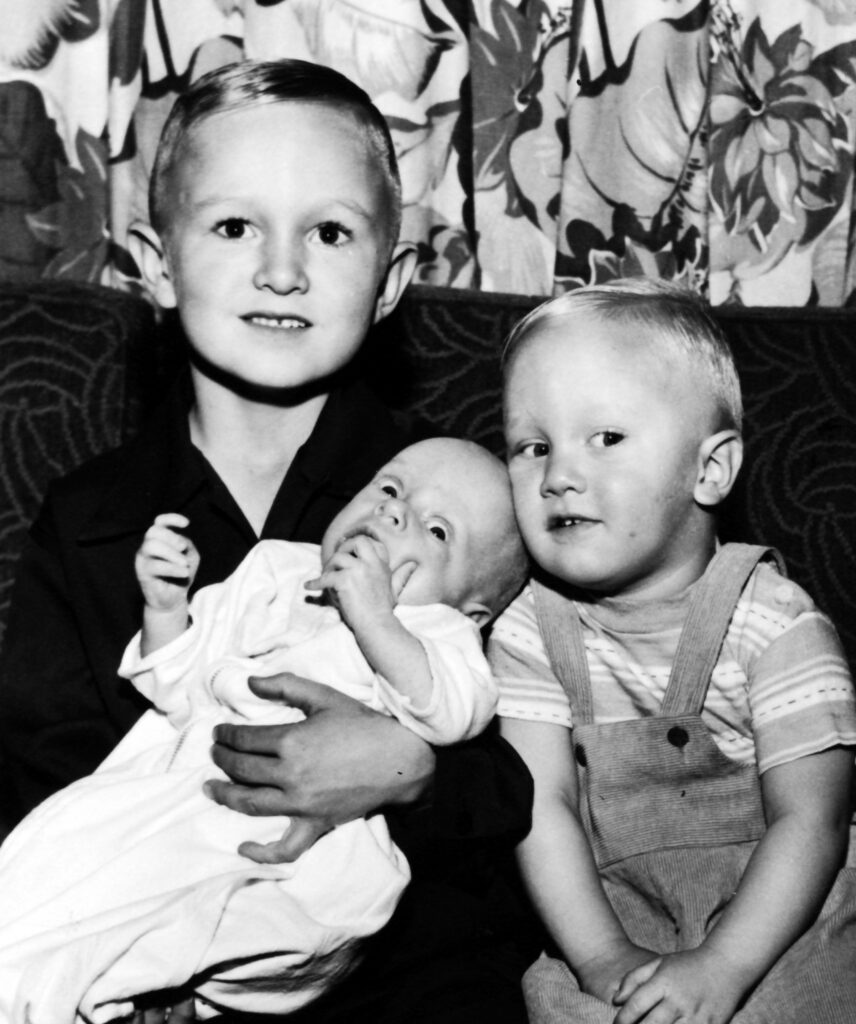
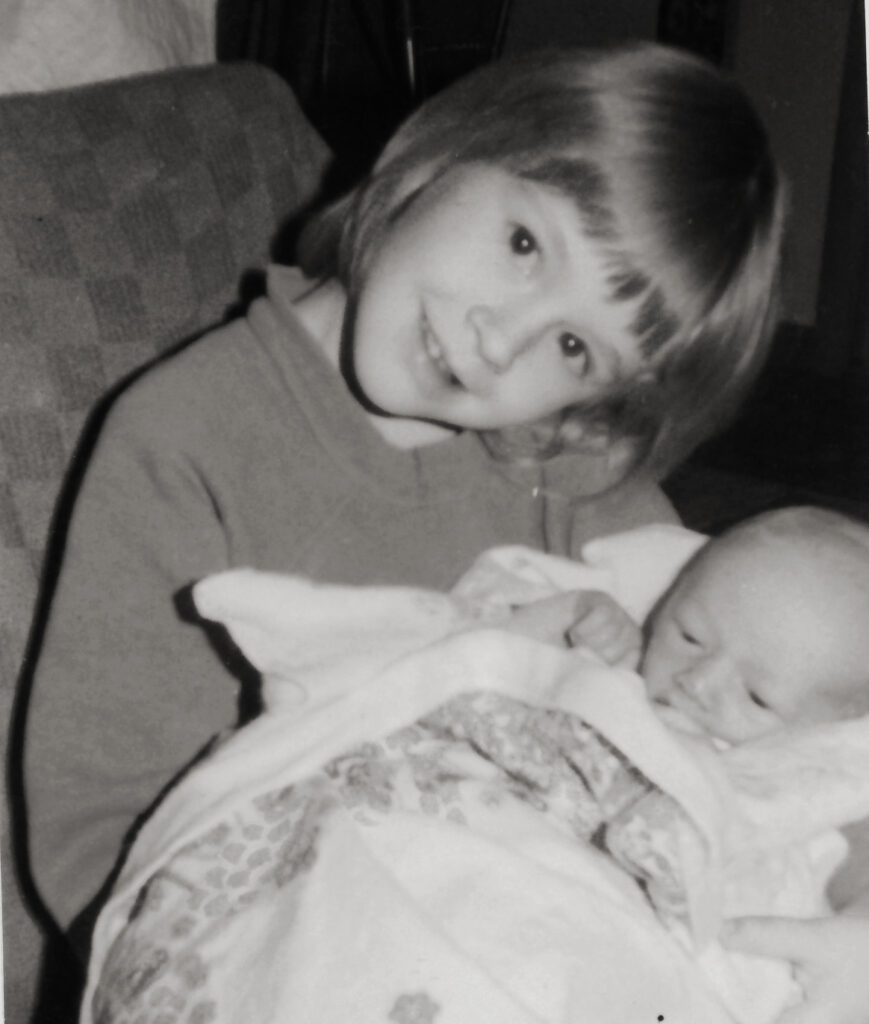
World War II ended in 1945 and Gene Treichler and Glen Miller returned from their overseas military assignments and rejoined their spouses in Grand Junction. During the late 1940s and early 1950s, four more grandchildren were born in Grand Junction: John Miller and Bette Treichler in 1946, Dennis Miller in 1951, and Ron Miller in 1952. Having the 5 grandchildren close by was a great joy to Effie and Hipe.
Hipe and Effie purchased a brand-new 1948 Chevrolet Fleetline 2-door sedan and began to take numerous trips in their Chevy, including several vacations to Iowa and California. When friends and relatives visited western Colorado, they were treated to one or more of Effie and Hipe’s favorite scenic locations. The Grand Mesa National Forest, with numerous trout-filled lakes and campsites, was located just east of Grand Junction. To the west was the Colorado National Monument, with deep canyons, unique sandstone formations, and picturesque vistas. Another favored spot for fishing and camping was Alkali Bend on the Gunnison River between Montrose and Gunnison, where Effie’s brother Perry McIntire had a cabin. Hipe and Effie also enjoyed the majestic mountain peaks around Ouray and the Rifle Falls State Park, which included a trio of 70-foot waterfalls.
Effie and Hipe purchased a slide projector and a projection screen so they could share photos they took on their adventures. Wilna taught Hipe how to golf and he played many a round at the Lincoln Park golf course, sometimes with Wilna and sometimes with other golfers, who were “mostly younger.”
Effie kept busy with Daughters of the American Revolution and First Baptist Church activities. Wilna, Edna, and Effie traced their Hall/McIntire ancestry back to the Revolutionary War in order to qualify for membership in the DAR. Effie was elected secretary of the local Mt. Garfield chapter of DAR and she made many friends in that patriotic organization.
At the First Baptist Church, located at Grand Avenue and 7th Street, Effie served as president of the Women’s Union and loved to attend Sunday school and church services. Hipe was a church trustee and he remarked that he and Effie met some “wonderful friends” at the church.
Hipe and Effie celebrated their 40th wedding anniversary in April 1946. Wilna and Edna surprised their parents with special recognition and bouquets of flowers at the First Baptist Church Sunday morning service. The two daughters knew life was uncertain and they wanted Effie and Hipe to have a nice celebration for their 40th anniversary. That was a good choice, since Effie was not in good health by the time of their 50th wedding anniversary in 1956 and she passed away just 7 months later.
In 1947 Effie learned of a shortage of local teachers. Since Hipe wanted to continue his work at the Parks Department, Effie decided to apply for a teaching job and she secured a position as a grade school teacher at Fruitvale Elementary. A return to teaching was enjoyable for Effie, but Hipe, Wilna and Edna saw the strain it put on Effie and they convinced her to stop teaching full-time after one year and to continue as a part-time tutor for the school district.
After Effie ended her full-time teaching, Hipe decided they should take a vacation. They drove to Southern California to visit their McIntire and Bridges relatives and to take in some sightseeing, including Knott’s Berry Farm and the San Diego Zoo. After the California trip, Effie remarked that if she couldn’t teach school anymore, she would take some classes at Mesa Jr. College. Mesa was conveniently located just 6 blocks north of their home and Effie enjoyed the college experience. In 1951 Effie graduated with an Associate in Arts degree from Mesa. Hipe reflected that “The day she walked down the aisle to get her diploma we were all there, so proud and happy. This had been a real struggle and she had made it. As usual, I had to wipe my eyes. And as usual, when Wilna saw me wipe my eyes, she had to wipe hers.”
In 1954 Hipe developed kidney stones and ended up in St. Mary’s hospital. The kidney stones were successfully dissolved without surgery, but Hipe decided he would have to give up his job at the Parks Department. He proudly noted he had worked full-time for a decade without a break. “Thinking back to my time at the Parks Department, I had many friends there, the only trouble was, they kept dying off on me!”
Effie’s health remained a concern for the couple, including gall bladder problems in 1952 that forced major changes in her diet. After Effie fell in the bathtub and dislocated her shoulder, she had difficulty fixing her hair, so Hipe became her hairdresser.
By 1954, Effie had developed serious memory issues. One day while she was shopping downtown, Effie could not find her car and she walked the 8 blocks back home. Hipe then walked to downtown, located the car, and drove it home. On a few occasions, Effie took off on her own and walked to Edna’s house 9 blocks away, and Effie would sometimes wander off and visit one of the neighbors. If I missed her, Hipe said, it wasn’t long before I would get a call that “Effie is over visiting me. I didn’t want you to worry.” Hipe decided to hire a health care worker to watch Effie for a couple of hours a day so he could rest.
In the 1950s, the varieties of dementia, including Alzheimer’s, were not well established. Wilna and Edna consulted with Dr. Munro, Dr. Smith, and a mental health specialist who told them Effie had age-related “hardening of the arteries” and the condition was leading to her memory loss. Effie informed Wilna that she knew something was terribly wrong with her, but she didn’t know what it was. Wilna told Effie that if there was a hospital that could help her, the family would see that Effie got there.
By the time of Hipe and Effie’s 50th wedding anniversary in April 1956, Effie was not healthy enough for a celebration, so Hipe and the two daughters arranged for a small family dinner and an anniversary announcement and photo of the couple that appeared in the Grand Junction Daily Sentinel. Several friends and relatives stopped by the house and the couple received numerous flowers and cards. Hipe lamented that “It was a nice day, although Mama never realized the occasion.”
There were nursing homes in Grand Junction, but Hipe was afraid they would either keep Effie drugged or confined to a room. Therefore, in the summer of 1956, Hipe, Wilna, and Edna decided to take the advice of Effie’s doctors and have Effie evaluated at the Colorado Mental Health Hospital in Pueblo to see if anything could be done for her dementia. After testing, the doctors in Pueblo said there was no cure for Effie’s condition, but that she could remain indefinitely in one of the dormitories at the hospital and receive inpatient care.
After they left Effie at the Mental Health Hospital in Pueblo, Hipe, Wilna, and Gene spent a week on Grand Mesa fishing and resting. Hipe, Wilna, and Edna continued to visit Effie often, and Hipe took Wilna’s son J.R. to the Colorado State Fair in Pueblo that August and they were able to visit with Effie. Hipe noted that Effie “looked great. She had been to the hospital’s beauty parlor and had on a pretty pink dress and was glad to see us.” Effie often seemed to recognize her visitors.
That summer was a difficult time for the family, but they were relieved because Effie believed she was in a college dormitory. Effie was happy and that made it easier for the others. Years later, Hipe reflected on Effie’s time in Pueblo: “It was a real blessing for us that mother thought she was attending college, for it would have ‘killed us’ if she had ever asked to come home or been unhappy. The Good Lord took care of all of us. I went over to see her every other week and Wilna and Edna went often. She always . . . looked so nice. . . . I just thank the Good Lord she was happy.”
On November 14, 1956, Effie died of pneumonia at the Colorado Mental Health Hospital in Pueblo. Her autopsy revealed that three-fourths of her brain was afflicted by abnormalities. Effie’s funeral was held in the chapel at Martin Mortuary in Grand Junction. Rev. Earl Gosa of the First Baptist Church officiated at the services. The pallbearers included friends Ralph Stocker, W. A. Altenbern, and Thomas Charles and relatives Donald Clark, C. N. Perry, and Paul Mellinger. Bruce Currier and the Martin Musicians sang hymns. After the chapel service, burial services were conducted at the Orchard Mesa Cemetery.
Over one hundred guests attended Effie’s funeral, including many from the Olathe area. Hipe was pleased at the abundance of flowers at the funeral, but he requested “When my time comes, don’t let people spend so much on flowers, . . . I’d rather have a scholarship for some young person who’s having a hard time going to college.” Honoring Hipe’s request, Wilna and Edna established a scholarship in Effie and Hipe’s name at the First Baptist Church.
After 50 years of marriage, at the age of 74, Hipe was now a widower and he faced what he called his “lonesome years.” What helped immensely during that period of adjustment was that Hipe had his two daughters close by, as well as the five grandchildren who were then between the ages of 4 and 13.
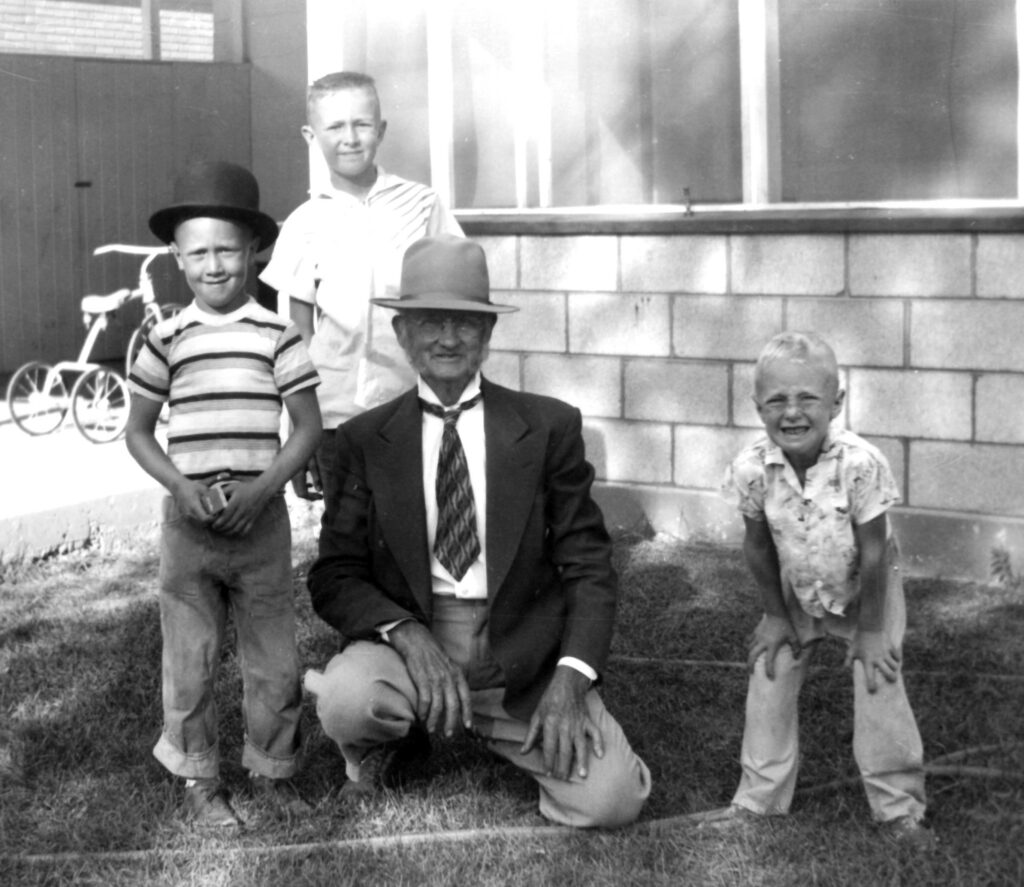
Hipe had many outdoor adventures with the grandkids. Fishing, sporting events, playgrounds, the local zoo, feeding ducks at the Duck Pond Park, and hiking and exploring in the surrounding hills were well-liked. In the winter, playing checkers, caroms, and dominoes with the grandkids was a popular way to pass the time. Hipe always kept a jar full of money in the house for the use of the grandchildren. J.R. was thankful he could borrow a few dollars to tide him over and he was always careful to return the loan promptly.
Hipe would occasionally get a phone call from the grandkids: “What are you doing, grandpa?” “Nothing” “How would you like to go hunt rocks up on Glade Park?” “I’d love to if I had someone to go with me.” “We’ll go with you grandpa.” “OK, I’ll be over and you get ready.”
A year after Effie’s death, Hipe joined Edna, Glen, John, Dennis, and Ron on an automobile trip to Southern California. Hipe was able to visit with several California friends and relatives, while the Miller family visited cousins and spent time at Disneyland and at the beach.
For 2 weeks every summer, the Treichler family — Wilna, Gene, J.R., and Bette — would camp and fish at Eggleston Lake on Grand Mesa. Hipe would usually drive up and spend a few days with them, often bringing one or more of the 3 Miller boys. Wilna and Gene had 2 large canvas tents and there were plenty of sleeping bags and cots for those who showed up.
Hipe greatly enjoyed fishing trips with Rod McIntire, one of Effie’s brother Oliver’s 6 children. Rod and his wife Elaine would visit from their home in Arizona; Elaine would stay in Grand Junction and Hipe and Rod would head for the top of Grand Mesa to spend a few days fishing. Rod’s father Oliver died when Rod was 26, so Hipe became a father-figure for his nephew. Hipe explained that “Rod said he missed his dad so much and he felt close to me. . . . Oliver’s poor kids just lost their dad so soon.”
Hipe took his first airplane ride in 1958 with his grandson John Miller. This trip was a 45-minute scenic flight that began and ended in Grand Junction. As a result of that brief flight, Hipe decided that airplane travel was not that difficult and over the years he took several airplane trips from Grand Junction to either Denver or to Iowa to visit friends and relatives. Hipe explained that these flights were easy because the United and Frontier airline employees made sure he made the proper connections.
In 1962, at the age 80, Hipe decided he would like to work again and he applied for a job as a security guard at the local Kuner canning factory. Hipe reflected on the interview: “That poor lady hardly knew what to say to me, was nice, but I didn’t get the job. I knew then I was destined to caring for people’s lawns. Of course, I could take my time on the lawns and work awhile and rest awhile. Maybe I had worked long enough. I could get by.”
In August 1965 grandson John Miller decided to visit with recruiters at two colleges in Kansas and Missouri and John invited Hipe to join him on a car trip to the colleges. The two would then drive north into Iowa and visit with relatives. Hipe gladly accepted the offer. Both Hipe and John had a great time on the trip – the 82-year-old grandfather and the 19-year-old grandson.
Hipe rode along with Edna to Olathe several times to visit with friends and relatives and to drive through the countryside. Occasionally, Hipe would board a Greyhound or a Continental Trailways bus in Grand Junction and ride the 50 miles to Olathe, where he would be met at the bus station by one of the Olathe relatives. Hipe also enjoyed going on outings to area locations in the First Baptist Church van with other senior citizens.
In June 1968 Hipe rode with Edna, Glen, Dennis, Ron, and Alice Mellinger to Fort Collins to see three graduations at Colorado State University: J.R. graduated with a B.S. degree in electrical engineering and with a commission as a second lieutenant in the Air Force; John graduated with a B.A. degree in history; and Bette’s fiancé Bob Essig graduated with a doctorate in veterinarian medicine. Bette attended CSU, married Bob in late June, 1968, and finished her B.A. degree in Art Education at California State College, Long Beach.
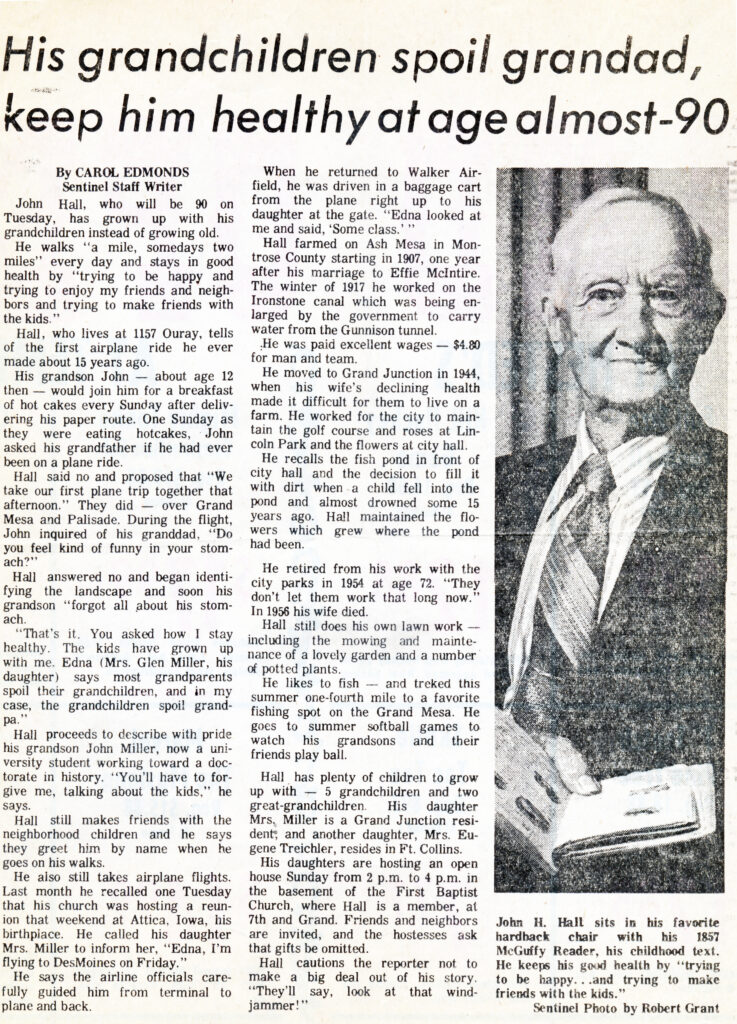
In October 1972 Hipe celebrated his 90th birthday. Wilna and Edna hosted a surprise party at the First Baptist Church and over 100 guests attended. The Daily Sentinel featured a lengthy article and photo of Hipe in the newspaper. In the newspaper story, Hipe recalled several incidents that had made his life so enjoyable, including that he had kept his good health for so long by trying to be happy and striving to make friends with the neighborhood children. He added that his grandchildren had spoiled their grandpa.
Hipe continued to enjoy retirement at his Ouray Avenue home, mowing his lawn and caring for the gardens and continuing to walk several blocks most days, using a cane for balance and to keep loose dogs from getting too close. Nevertheless, Hipe decided at age 90 it was time for a change. He had not felt well for a few months and Hipe suffered from prostate problems and general shakiness. The shakiness bothered Hipe because it was hard to write checks. Edna and Glen had a spare bedroom available, so Hipe arranged for his nephew, local Realtor Ken McIntire, to sell the home on Ouray and Hipe moved in with Glen and Edna. Hipe made sure he kept his room clean and he insisted on paying for his “room and board.” At that time, Wilna and Gene were living in Fort Collins, Colorado and Hipe spent time with them as well.
During his later years, Hipe was delighted to become a great-grandfather for three children. His first great-grandchild, Mark Miller, was born in 1970. Mark was the son of John and Letty Miller, who lived in West Lafayette, Indiana. Hipe was able to enjoy time with Mark when the Miller family vacationed in Colorado during the summers.
Hipe’s second and third great-grandchildren were Dawn Essig, born in 1971, and Leon Essig, born in 1976. Dawn and Leon were the children of Bette and Bob Essig, who lived in Burwell, Nebraska, where they owned a veterinary clinic. When Hipe was staying with Wilna and Gene in Fort Collins, Hipe was always ready when Wilna and Gene asked if he wanted to ride with them to Burwell. While in Nebraska, Hipe loved to join Bob as he made his veterinary rounds in the countryside.
Hipe continued to fly to Iowa for a visit most years. In 1973, at the age of 90, Hipe took a flight to Iowa for a reunion in Attica, the town of his youth. In 1974, Hipe flew to Des Moines and visited with several friends and relatives. While in Iowa, Hipe’s sister-in-law Lulu (the widow of Hipe’s brother Curtis Hall) offered to drive him from Iowa to Indiana (Lulu was “only” 67 years old at the time) so Hipe could visit with John, Letty, and Mark Miller, as well as see Lulu’s son Frank Hall and wife Anna, who also lived in Indiana.
The year 1976 was a busy one for Hipe and it was destined to be the last year of his “honey” of a life. In May, Grand Junction celebrated the Centennial of Colorado’s 1876 admission to the Union. A senior citizen parade was part of the Centennial celebration and Hipe participated by riding in the back of a 1931 Ford convertible with Dr. Elroy Shikles, the pastor of the First Baptist Church.
Hipe made what was destined to be his last trip to Iowa in July 1976. He flew to Des Moines and “had a wonderful time and everyone was so nice to me.” Hipe then flew back to Denver and stayed for a few weeks with Wilna and Gene in Fort Collins.
By 1976, Hipe had developed glaucoma in one eye and a cataract in the other eye. In September Hipe decided to have cataract surgery. He had debated about having the surgery, but ultimately Hipe decided he wanted to have better eyesight for his remaining years. Hipe came through the cataract surgery with no problem, but then had two quick strokes and passed away at St. Mary’s Hospital on Sunday, September 26, 1976.
As Hipe reflected on his life shortly before his death, he offered the following: “Really, what a wonderful life I’ve had. I’ve had sorrows but have been blessed with two daughters and their families who’ve been good to me. . . . I know I’ve made mistakes; hope I’ve been forgiven. . . . I’ve had a wonderful life, enjoyed most of it. I want to stay as long as God Almighty will let me, and I want to set a good example, be kind to everyone and make people happy.”
Edna wrote that “Hipe and Effie saw many changes during their lifetimes. They saw electricity take the place of gas lighting, automobiles replace horse-drawn carriages, and witnessed the arrival of radio, television, airplanes, men on the moon, and computers. They were remarkable parents who constantly gave their daughters support and encouragement. Our lives were wonderfully enriched by their love.”
The most complete source of information on John Hipe Hall and Effie McIntire is “It’s Been a Honey; ‘Old Dad’ Reminisces,” a typed collection of stories that was compiled in 1983 by Hipe and Effie’s daughter Wilna (Hall) Treichler. Additional material is found in: “Hall Family Genealogies” by Effie and Hipe’s daughter Edna (Hall) Miller, assisted by John W. Miller, 1983; Letter to the Editor of the Olathe Express by Martin Luther McIntire, @1927; History of Marion County, Iowa, 1881 and 1975; Marion County Iowa 1875; Atlas of Marion County, Iowa, 1901; Mesa County Clerk and Recorder’s Office property deed records; 1950 U.S. Census records; and two stories available on Ancestry.com: “Early Years in Kansas” by Effie (McIntire) Hall, 1950, edited by John W. Miller; and “A Trip to Iowa with Hipe Hall,” story by John W. Miller.
Prepared by John W. Miller
Comments welcome at theoldprofessor7@gmail.com